
The Most Important Factors to Consider When Buying an NFC Display to Get Google Reviews
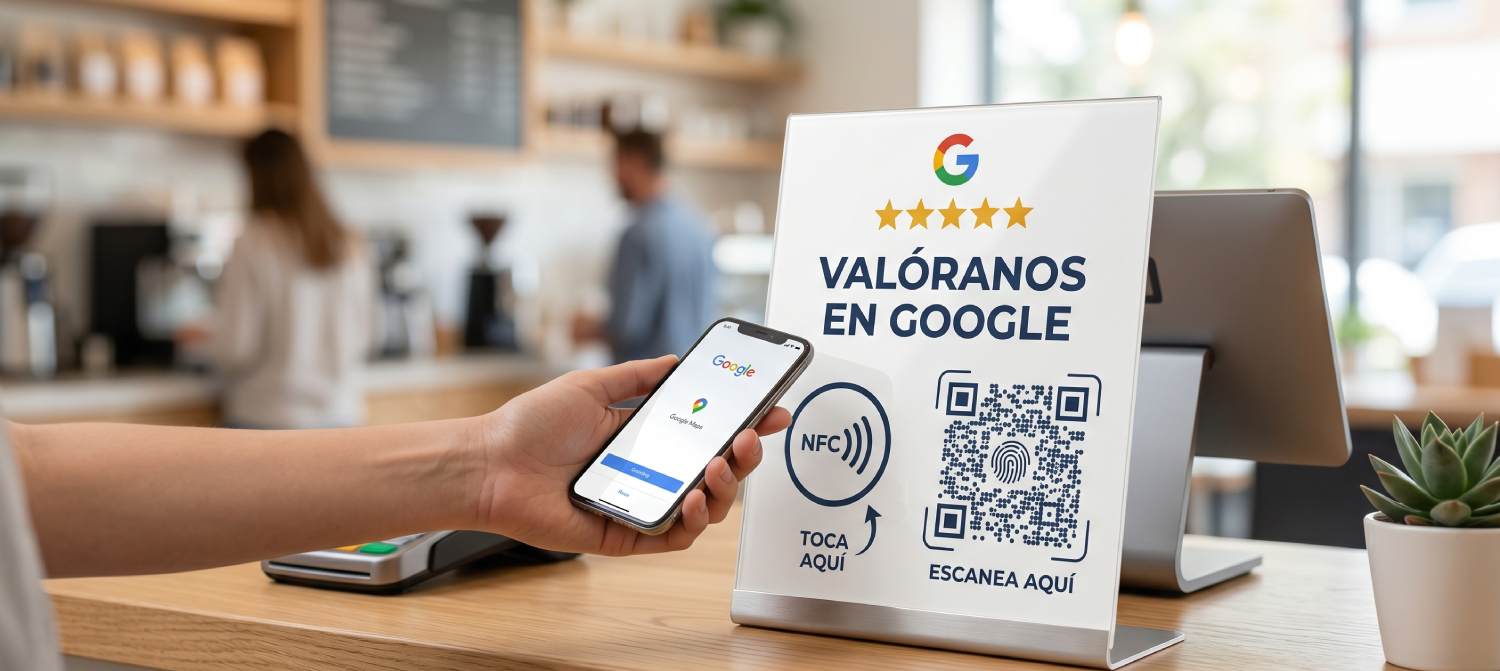
A technical and operational guide for local shops and businesses
In today's digital ecosystem, Google My Business reviews are one of the fundamental pillars of local search ranking (local SEO) and of building trust with potential customers. To make this process easier at the physical point of sale, NFC and QR review displays have established themselves as the most effective direct-conversion tool.
However, the growing range of products on the market shows critical differences in security, usability, running costs and legal compliance. Below are the key factors every business should analyse thoroughly before purchasing a review display, to avoid unpleasant surprises or serious penalties.
1. Balanced dual technology: NFC and QR must both be present
A frequent mistake in certain devices on the market is to leave out the QR code entirely or relegate it to a secondary visual role. To guarantee the highest customer-to-review conversion rate, the display must integrate both technologies with equal visual prominence, for two critical demographic and technical reasons:
- Generational inclusion: while younger customers are used to NFC technology, a significant percentage of older customers associate digital interaction exclusively with scanning QR codes.
- Hardware compatibility: not every mobile device on the market has its NFC chip enabled by default, or has one at all. The absence of a visible QR code completely blocks these users from leaving a review.
2. Advanced security against fraud and tampering
Physical displays are continuously exposed to the public on counters, tables and reception desks. This introduces physical and digital security risks that must be covered out of the factory.
Password-protected NFC chip
Any user with basic knowledge and free tag-editing apps (such as NFC Tools) can rewrite an unprotected NFC chip in a matter of seconds. If the display does not come with a chip password-protected at the factory, a malicious third party or a competitor could redirect the device to a fraudulent website, a virus or another business's listing.
QR code with anti-fraud elements
Fraud through overlaid physical stickers is a common technique on the rise. Generic, flat QR codes make it easy for anyone to stick an adhesive QR on top without staff noticing at a glance. Advanced designs solve this by integrating complex visual elements or logos into the QR pattern itself, raising the difficulty of forgery and making any overlay attempt immediately detectable.

Operational security alert: a display without password protection on its NFC chip and without an anti-fraud QR design represents a critical vulnerability for your brand's online reputation and your customers' cybersecurity.
3. Economic viability: the danger of hidden subscriptions
The cost model is one of the areas where providers differ the most. It is crucial to distinguish between two very distinct commercial approaches:
- One-off payment with no fees (recommended model): the customer buys the hardware already configured and the service works for life with no additional charges. It offers the best long-term return.
- Recurring subscription models: some providers sell the physical product at standard prices but require mandatory monthly fees (which can reach €25/month) under the pretext of using their redirection platform. This turns a one-off purchase into a perpetual, unnecessary fixed cost just to redirect traffic to a public Google link.
4. Strict compliance with Google's policies (avoiding penalties)
Certain providers try to attract businesses by offering intermediary platforms that perform "review filtering", also known as review gating. This system intercepts the user's action: if the rating is positive (4 or 5 stars), they are allowed through to Google; if it is negative, they are redirected to an internal contact form.
Account suspension risk: systematically filtering opinions is strictly prohibited by the Google My Business terms of service. Using displays linked to these practices can lead to the permanent suspension of the business listing and the total loss of all accumulated reviews.
5. User experience: a clear CTA and a timeless design
Consumer behaviour at the point of sale is fast and impulsive. The display's design must therefore act as an immediate trigger:
- A crisp call to action (CTA): direct, unambiguous messages such as "Rate us on Google" convert drastically better than designs that use confusing icons or ambiguous wording.
- Professional look and durable materials: the stand should match the establishment's corporate image. It is advisable to rule out options made of ultra-cheap PVC or with excessively small dimensions from mass-import Asian platforms, as they degrade quickly and project a poor image. A minimalist, elegant design guarantees greater aesthetic durability over time.
6. Setup and implementation complexity
When assessing the real cost of a display, you must factor in the time required to get it up and running:
Extremely low-cost alternatives usually arrive completely empty or "blank". They force the buyer to download third-party technical apps, locate the exact URL of their Google profile (a complex process for non-technical users) and manually program each device one by one. The optimal choice is a provider that delivers the product fully personalised and ready to work from the very first second (plug & play).
Summary: decision matrix
| Factor | Optimal setup (recommended) | Risky setup (avoid) |
|---|---|---|
| QR / NFC balance | Both elements with the same size and visual weight. | No QR code, or a design that hides the NFC. |
| Digital security | NFC chip locked with a factory password. | Open chip editable by any user. |
| Physical security | Complex QR code with built-in anti-fraud elements. | Plain conventional QR, easy to cover with stickers. |
| Cost structure | One-off payment for the hardware. No subscriptions attached. | Monthly fees or paid configuration apps. |
| Google compliance | Direct, transparent link to the official listing. | Harmful intermediary review-filtering platforms. |
| Getting started | Personalised delivery, ready for immediate use. | Mandatory manual programming by the business. |
Conclusion
Buying an NFC display to capture reviews should not be based solely on the initial price. Essential elements such as protection against hacking, universal usability through a properly sized QR code and strict compliance with Google's rules determine the real success and long-term viability of the investment. A secure, transparent stand with no recurring costs is the most solid option for growing any business's online reputation organically and safely.